
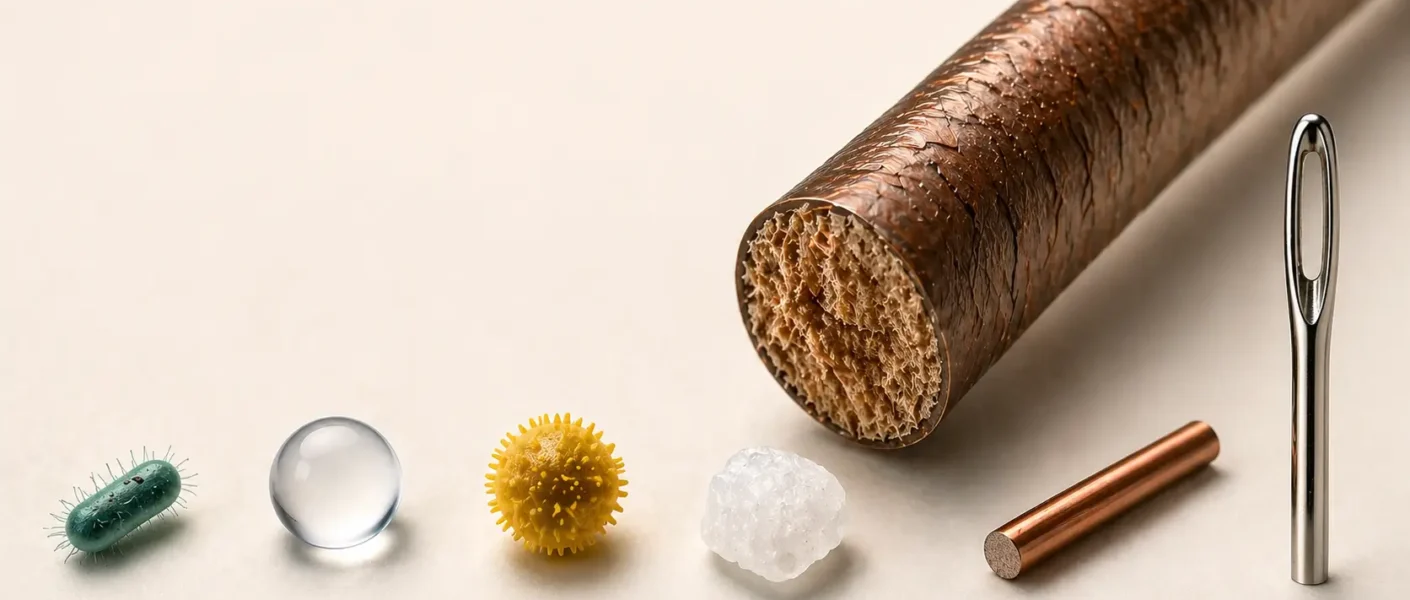
The diameter of human hair is a fundamental metric in forensic science, dermatology, and the cosmetic industry. While often perceived as a uniform measurement, the thickness of a human hair follicle is highly variable, influenced by genetics, ethnicity, age, and environmental factors.
On average, the diameter of human hair ranges from 17 to 181 micrometres (μm). To put this in perspective, a micrometre is one-millionth of a metre. Most researchers agree that the median thickness for a healthy adult is approximately 70 to 75 micrometres.
Quick Summary: Human Hair Diameter at a Glance
| Hair Category | Diameter in Micrometres (μm) | Common Comparison |
|---|---|---|
| Very Fine | 17 μm – 50 μm | Silk thread |
| Medium/Average | 50 μm – 90 μm | Standard printer paper |
| Coarse/Thick | 90 μm – 181+ μm | Fine copper wire |
The Biology of Hair Thickness
The diameter of a hair strand is determined by the size of the hair bulb located within the dermal papilla. The thickness is specifically dictated by the volume of the cortex and the presence (or absence) of the medulla.
- The Cuticle: The outermost protective layer, consisting of overlapping scales. While it contributes to the overall diameter, it is rarely the primary factor in thickness.
- The Cortex: The thickest layer, containing keratin bundles and melanin. This section determines the bulk of the hair’s diameter and its mechanical strength.
- The Medulla: The innermost core, often found only in thick or coarse hairs. Fine hair frequently lacks a medulla entirely.
Factors Influencing Hair Diameter
1. Ethnicity and Genetic Ancestry
Ethnicity is the most significant predictor of hair cross-sectional area and diameter.
- Asian Hair: Generally possesses the largest diameter, often exceeding 80–120 μm. It is typically circular in cross-section, which contributes to its straight appearance and significant tensile strength.
- European (Caucasian) Hair: Occupies the middle ground, with an average diameter of 65–80 μm. The cross-section is usually oval.
- African Hair: While it can feel “thick” due to density and curl pattern, individual strands are often finer than Asian hair, ranging from 40–70 μm. Its cross-section is flattened or elliptical, which creates “twist points” where the hair is thinnest and most prone to breakage.
2. Age and Hormonal Shifts
Hair diameter is not static throughout a person’s life.
- Infancy: “Vellus” hair is exceptionally fine, often under 30 μm.
- Adulthood: Hair typically reaches its peak diameter in the late 20s or early 30s.
- Senescence: As individuals age, the hair follicles miniaturize. This process, often accelerated by Androgenetic Alopecia (pattern baldness), results in a progressive decrease in diameter, leading to what is commonly perceived as “thinning.”
3. Anatomical Location
The diameter varies significantly depending on where the hair is located on the body. Terminal hairs on the scalp are generally thinner than eyebrows or pubic hair, while “peach fuzz” (vellus hair) found on the face and arms represents the smallest end of the human hair diameter spectrum.
Measuring Hair Diameter: Scientific Methods
Precision is vital in clinical and forensic settings. Scientists use several advanced tools to measure hair thickness:
- Optical Microscopy: The most traditional method, using a calibrated micrometer eyepiece.
- Scanning Electron Microscopy (SEM): Provides high-resolution imagery of the cuticle and allows for nanometer-scale precision in diameter measurement.
- Laser Diffraction: A non-destructive method that measures the pattern of light scattered by a hair strand to calculate its width.
- Micrometers: Mechanical or digital calipers used in salon settings or home experiments, though these are less accurate for elliptical (curved) hair types.
Why Hair Diameter Matters
Forensic Science
In criminal investigations, hair diameter and cross-sectional shape help forensic odontology and biology experts include or exclude suspects. While hair is not as unique as DNA, its morphological characteristics—like a specific diameter range or medullary index—provide critical circumstantial evidence.
Cosmetic Formulation
The beauty industry categorizes products based on hair diameter.
- Fine Hair: Requires lightweight polymers that provide volume without weighing the cortex down.
- Coarse Hair: Benefits from heavy lipids and silicones that can penetrate or coat the larger surface area to reduce rigidity.
Health and Nutrition
Sudden changes in hair diameter can be a clinical indicator of nutritional deficiencies. For example, Protein-Energy Malnutrition (PEM) or severe iron deficiency (Anemia) can lead to the production of “flagged” hair, where sections of the strand are significantly thinner and depigmented.
Comparison with Common Objects
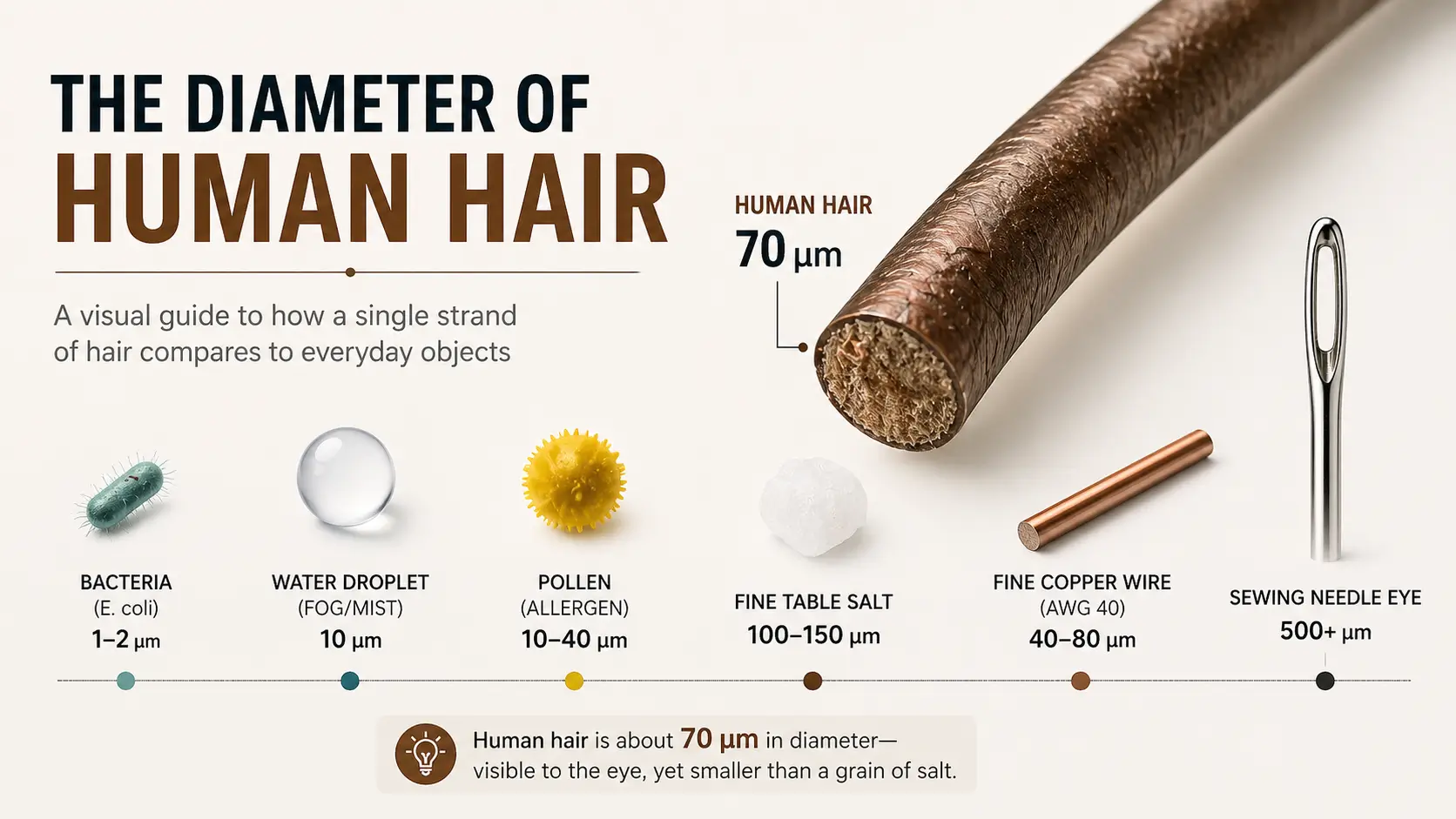
To appreciate the scale of human hair diameter, one must move beyond simple measurements and look at the physics of visibility and material density. At an average of 70 micrometres (μm), a single strand of hair sits at the very edge of what the unaided human eye can perceive—the “limit of resolution” for most people is approximately 40 to 50 μm.
The following comparisons provide a deeper scientific context for how hair diameter interacts with the world around us:
1. The Cellular Scale: Red Blood Cells (~8 μm)
A human hair is roughly 9 to 10 times wider than a red blood cell. While a blood cell is small enough to navigate capillaries that are only 5–10 μm wide, a single strand of hair would completely obstruct even the largest capillary. This comparison highlights why hair is considered a macro-structure in biology, despite its perceived fineness.
2. The Micro-Particle Scale: Pollen and Dust (10–40 μm)
Most common allergens, such as ragweed pollen or household dust mite waste, are significantly smaller than the diameter of a human hair. A typical hair strand is two to three times thicker than a grain of highly allergenic pollen. This is why hair acts as an effective physical filter; the spacing between hairs on the body (like eyelashes or nasal hair) creates a mesh that can trap these smaller particulates before they reach sensitive membranes.
3. The Industrial Scale: Standard Printer Paper (~100 μm)
Many people assume hair is thinner than paper, but the gap is smaller than expected. A standard sheet of 20lb office paper is roughly 100 μm thick. This means a medium-to-thick human hair is nearly 70–80% as thick as a piece of paper. However, because paper is flat and hair is cylindrical, the “visual weight” of paper appears much greater, even though their dimensional thicknesses are comparable.
4. The Precision Scale: Fine Copper Wire (~40–80 μm)
In electronics, “fine” magnet wire used in miniature motors or headphones is often manufactured to match the diameter of human hair. An AWG 40 wire is approximately 80 μm in diameter. This comparison is vital in forensic science; under a microscope, a copper wire and a hair strand can look remarkably similar in gauge, though the hair exhibits biological irregularities (like cuticle scales) while the wire remains a perfect, smooth cylinder.
5. The Environmental Scale: Fine Sand (~90 μm) and Mist (10–100 μm)
Geologically, “very fine sand” is classified as anything down to 62.5 μm. This means that a single strand of hair is often thicker than the individual grains of sand found on a powdery white beach. Similarly, the water droplets in a heavy fog or mist range from 10 to 100 μm. When you feel “damp” in a fog, it is because thousands of water droplets, many of which are exactly the same diameter as your hair, are adhering to the hair shaft via surface tension.
Summary Table of Comparative Scales
| Object | Diameter (μm) | Scale Relative to Hair (70 μm) |
|---|---|---|
| Bacteria (E. coli) | 1 – 2 μm | 1/70th the width |
| White Cloud Droplet | 10 μm | 1/7th the width |
| Human Hair | 70 μm | The Baseline |
| Fine Table Salt | 100 – 150 μm | 1.5x to 2x wider |
| Sewing Needle Eye | 500+ μm | 7x+ wider |
The “Fine” vs. “Thin” Distinction
In trichology, it is crucial to distinguish between diameter and density.
- Fine hair refers to a small diameter of the individual strand.
- Thin hair refers to a low density of hairs per square inch on the scalp.
A person can have “thick” hair (high density) that is “fine” (small diameter), or vice versa.
Conclusion
The diameter of human hair is a complex biological trait that serves as a window into an individual’s genetics, age, and health. Ranging from the ultra-fine 17 μm vellus hairs to the robust 180 μm coarse strands found in specific ethnic groups, the “average” human hair remains one of the most versatile and studied fibers in biological science. Understanding these dimensions is essential for anyone involved in dermatology, forensic analysis, or professional hair care.