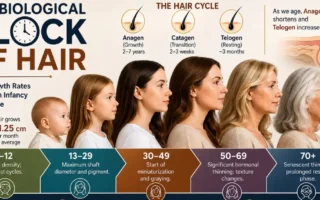
For those seeking the “holy grail” of hair care, the elusive one-inch-per-month growth rate—the reality is a blend of biological hard limits and optimisable lifestyle factors. While the average person sees their hair grow approximately 0.5 inches (1.25 cm) per month, reaching the one-inch mark is a biological outlier, typically reserved for those with specific genetic predispositions and peak metabolic health.
The Biological Reality: Why One Inch is Rare
Human scalp hair grows at an average rate of 0.5 to 1.7 centimetres per month. This translates to a broad range of 0.2 to 0.7 inches. Most people can expect about 6 inches of growth per year, provided the follicles are healthy and the body is well-nourished.
The Anagen Phase: Your Growth Engine
Hair growth occurs exclusively during the Anagen phase, the active proliferation period of the hair follicle. Approximately 85–90% of your hair is in this state at any given time. The speed and duration of this phase are governed by:
- Genetics & Signaling Molecules: Your DNA regulates the production of IGF-1 (Insulin-like Growth Factor), which signals cells to divide. Some individuals naturally produce higher levels, pushing them toward that 1-inch threshold.
- Ethnicity & Statistical Variance: Research published in the International Journal of Dermatology highlights distinct baseline growth rates:
- Asian hair: The fastest, averaging 1.3 cm (approx. 0.51 in) per month.
- Caucasian hair: Grows at an average of 1.2 cm (approx. 0.47 in) per month.
- African hair: The slowest, averaging 0.9 cm (approx. 0.35 in) per month, often due to a higher frequency of “micro-snaps” along the shaft.
- Hormonal Influence: Androgens and Oestrogens modulate the growth cycle. While oestrogen extends the anagen phase, high levels of cortisol (stress) can prematurely “shock” follicles into the resting phase, known as Telogen Effluvium.
Factors That “Fast-Track” Growth
While you cannot rewrite your genetic blueprint, you can remove the “biological brakes” that prevent you from reaching your maximum velocity.
1. Nutritional Synchrony & Bioavailability
Hair is a non-essential tissue. When the body enters a “triage” state due to nutrient deficits, it diverts resources away from the scalp to vital organs.
- The Keratin Scaffold: Hair is 97% protein. Clinical dietary guidelines suggest a daily intake of at least 50g of protein to support the metabolic demands of the follicle. Focus on L-Cysteine and L-Methionine—sulphur-rich amino acids that create the disulphide bonds responsible for hair strength.
- Metabolic Catalysts: Iron (Ferritin) is critical; it carries oxygen to the follicle’s bulge area. According to leading trichologists, if serum ferritin levels drop below 70 ng/mL, the body may truncate the growth cycle to conserve energy, leading to excessive shedding.
- Micronutrient Synergy: Vitamin D3 acts as a hormone that “wakes up” dormant follicles, while Biotin (B7) supports the infrastructure of keratin production.
2. The Scalp Micro-Environment
A healthy scalp is the “soil” for your hair. Growth is a high-energy process requiring immense vascular support.
- Vasodilation: Dermatological studies show that 4-minute daily scalp massages stimulate the stretching of dermal papilla cells, increasing hair thickness and encouraging faster turnover through mechanical gene stimulation.
- The Microbiome: Overgrowth of fungus (Malassezia) or sebum buildup causes micro-inflammation. This creates oxidative stress at the root, which can physically impede the rate of cellular division.
The Retention Trap: Why Hair “Stops” Growing
Often, hair is growing perfectly at the root, but it is “vanishing” at the ends. This is Perceived Stagnation.
- The Weathering Effect: Exposure to UV rays and hard water minerals degrades the lipid layer of the hair. Once this hydrophobic shield is gone, the hair becomes porous and snaps.
- Mechanical Fatigue: Repeated “hygral fatigue”—the swelling and shrinking of hair when it gets wet and dries—weakens the cortex. Using silk pillowcases reduces the friction-based snapping that negates monthly gains.
- The Trimming Paradox: Trims do not impact the root, but they remove trichoptilosis (split ends). This prevents a split from traveling up the hair shaft, which would otherwise require a much larger cut later.
Professional Support & Targeted Solutions
Based on clinical dermatological standards, the following interventions can artificially extend the growth phase:
- Minoxidil: A potassium channel opener that keeps follicles in the Anagen phase longer than they would naturally stay.
- Low-Level Laser Therapy (LLLT): Uses specific light wavelengths to stimulate ATP (cellular energy) production within the follicle mitochondria.
- PRP (Platelet-Rich Plasma): Injects concentrated growth factors directly into the scalp to “jumpstart” sluggish or miniaturized follicles.
The Verdict: While 1 inch per month is a biological rarity, 0.7 inches is achievable for many. By synchronizing internal nutrition with external protection, you can ensure your hair reaches its maximum physiological potential.