Hair is one of the most dynamic tissues in the human body, second only to bone marrow in its rate of cellular proliferation. However, this “growth engine” is not constant. From the peach fuzz of a newborn to the thinning strands of the golden years, the rate, texture, and density of hair are governed by a complex interplay of genetics, hormones, and cellular senescence.
Understanding the hair growth rate by age is not just about aesthetics; it is a window into our systemic biological health.
The Fundamentals: The Hair Cycle and Baseline Speed
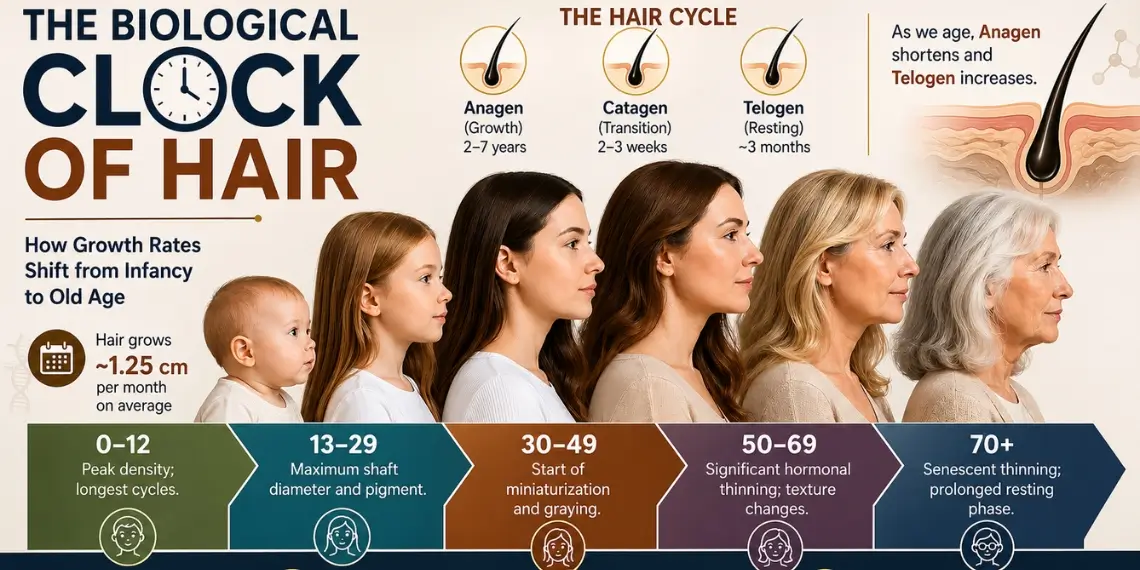
Before diving into age-specific data, we must establish the baseline. On average, human scalp hair grows about 0.35 millimetres per day, which translates to roughly 1.25 centimetres (0.5 inches) per month, or 15 centimetres (6 inches) per year.
This growth occurs in three phases:
- Anagen (Growth): Lasts 2–7 years.
- Catagen (Transition): Lasts 2–3 weeks.
- Telogen (Resting): Lasts ~3 months.
As we age, the duration of the Anagen phase shortens, while the percentage of hairs in the Telogen phase increases.
1. Infancy and Childhood: The Rapid Ascent
In the first few years of life, hair undergoes dramatic transitions. Most infants lose their “birth hair” within the first six months due to a synchronized shedding event called telogen effluvium.
Growth Characteristics: Once the permanent terminal hair sets in (usually by age 2), childhood marks the period of highest hair density.
The Data: Studies indicate that prepubescent children often have the longest Anagen phases, sometimes extending up to 7 or 8 years. This is why children can often grow hair to their waist more easily than adults.
During this stage, follicular density is at its peak because the scalp surface area is small relative to the number of follicles we are born with (roughly 5 million total, with 100,000 on the scalp).
2. Adolescence and the 20s: The Peak Performance
During puberty, a surge in androgens (testosterone and its derivative DHT) transforms vellus hair (fine, light hair) into terminal hair (thick, pigmented hair) in areas like the axilla and pubic region.
Growth Rate: This is the biological “prime” for hair. Growth is at its most consistent, and the hair shaft diameter is at its thickest.
Clinical Insight: A study published in the Journal of Investigative Dermatology notes that the metabolic activity of the dermal papilla—the command centre of the hair follicle—is highest in the late teens and early 20s.
The “Golden Year” Stats: In your 20s, approximately 90% of your hair is in the Anagen phase at any given time.
3. The 30s and 40s: The Subtle Slowdown
For many, the 30s are a turning point. This is when the cumulative effects of “extrinsic aging” (UV exposure, pollution) and “intrinsic aging” (hormonal shifts) begin to manifest.
- The Growth Shift: The rate may drop slightly from 1.25 cm/month to roughly 1.1 cm/month. While seemingly negligible, the bigger change is in hair diameter.
- Miniaturization: In those predisposed to Androgenetic Alopecia (pattern baldness), follicles begin to shrink. This process, known as follicular miniaturization, means that even if the hair grows, it emerges thinner and more fragile.
Research in Dermatologic Clinics highlights that by age 40, the scalp begins to show a decrease in sebum production, leading to hair that feels drier and is more prone to breakage, which often mimics a slower growth rate.
4. The 50s and 60s: The Impact of Menopause and Senescence
This era is defined by significant hormonal restructuring. For women, the decline of estrogen and progesterone during menopause leaves hair follicles more vulnerable to the shrinking effects of androgens.
Research suggests that after age 50, the average hair growth rate can slow down to about 0.8 cm to 1 cm per month.
The Graying Factor: This age bracket also sees the exhaustion of melanocyte stem cells. As hair loses pigment (melanin), the structure of the hair changes. Gray hair is often coarser but has a thinner cuticle, making it appear “frizzy” despite growing more slowly.
Cycle Changes: The Anagen phase may shrink to only 2–3 years, meaning the “maximum reachable length” of hair decreases significantly.
5. 70s and Beyond: The Dormant Phase
In the geriatric stage, the body prioritizes cellular energy for vital organs, often at the expense of non-essential tissues like hair.
Senescent Alopecia: Distinct from pattern baldness, this is an age-related thinning across the entire scalp. The number of active follicles decreases.
The Growth Rate: Growth can become sporadic and significantly slower. The “rest” (Telogen) phase lengthens, meaning once a hair falls out, it takes much longer for the follicle to “wake up” and start a new cycle.
Factors That Influence Growth Rate Across All Ages
1. Nutrition and Ferritin Levels
A study in the Journal of Korean Medical Science found a direct correlation between serum ferritin (iron stores) and hair growth. Regardless of age, if ferritin levels drop below 70 ng/mL, the Anagen phase can prematurely switch to Telogen.
2. The Role of Vitamin D
Vitamin D receptors are crucial for initiating the hair cycle. Low Vitamin D is a common culprit for “stagnant” hair growth in older adults who may spend less time outdoors.
3. Scalp Microcirculation
As we age, the capillary network supplying the dermal papilla can degrade. Scalp massages and certain topicals (like minoxidil) work by artificially stimulating this blood flow to mimic a “younger” nutrient delivery system.
Summary Table: Hair Growth Expectations by Decade
| Age Group | Avg. Monthly Growth | % in Anagen (Growth) | Primary Characteristic |
|---|---|---|---|
| 0–12 | 1.3 cm+ | 90–95% | Peak density; longest growth cycles. |
| 13–29 | 1.25 cm | 90% | Maximum shaft diameter and pigment. |
| 30–49 | 1.1 – 1.2 cm | 85% | Start of miniaturization and graying. |
| 50–69 | 0.9 – 1.0 cm | 75–80% | Significant hormonal thinning; texture changes. |
| 70+ | < 0.8 cm | < 70% | Senescent thinning; prolonged resting phase. |
Conclusion: Can You “Defy” the Age Rate?
While you cannot stop the biological clock, you can optimize the environment. High-protein diets, maintaining iron and Vitamin D levels, and reducing oxidative stress through scalp care can help you maintain your personal maximum growth rate for longer.
The goal isn’t necessarily to make hair grow faster than its genetic limit, but to ensure it doesn’t grow slower than it needs to due to neglected health.