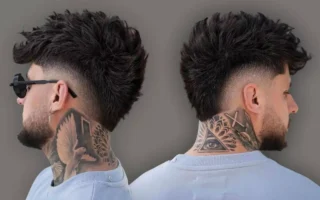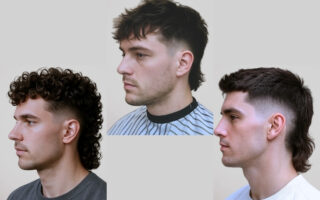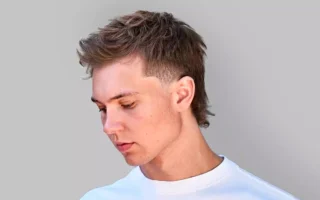
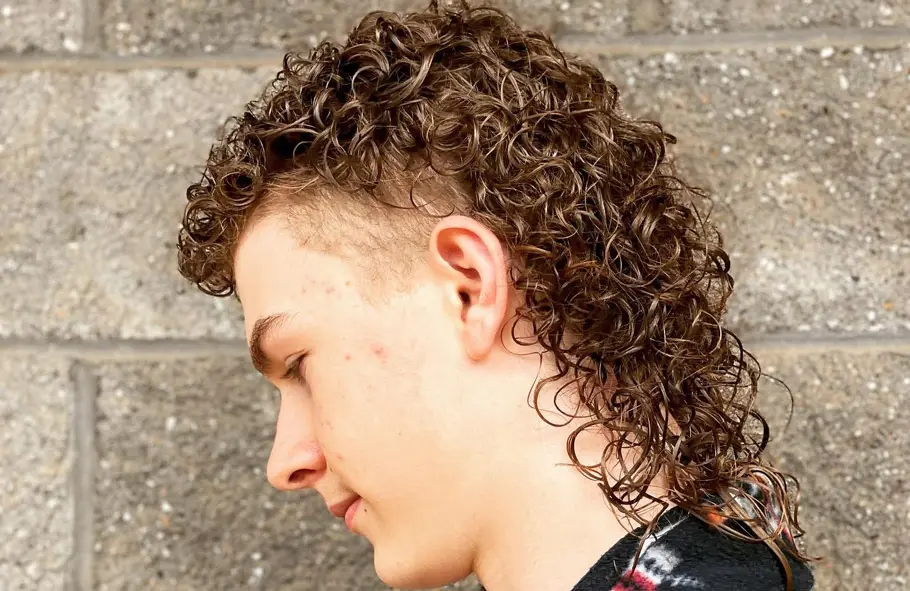
The permed mullet, often affectionately dubbed the “party in the back, curls in the front”—has transitioned from a vintage relic to a cornerstone of modern hair fashion. However, because this style involves both a structural cut and a chemical texture change, its lifespan is governed by a complex interplay of biology and chemistry.
If you are considering this bold aesthetic, the primary question is: How long does a permed mullet actually last?
On average, a permed mullet maintains its intended shape and texture for 3 to 6 months. However, “lasting” is subjective; while the curls may physically remain in the hair, the silhouette of the mullet evolves as your hair grows.
The Science of the Perm: Chemical Duration
To understand longevity, we must look at the hair’s cortex. A perm works by using a reducing agent (usually ammonium thioglycolate) to break the disulfide bonds that give hair its natural structure. Once the hair is wrapped around a rod, a neutralizer (hydrogen peroxide) reforms those bonds into a new, curly shape.
- Permanent vs. Semi-Permanent: Despite the name, a “perm” is technically permanent. The hair that has been chemically treated will stay curly until it is cut off.
- The “Relaxation” Phase: Studies in cosmetic chemistry suggest that within the first 2 weeks, a perm can lose up to 10–15% of its initial curl tightness as the bonds stabilize. This is often when the mullet looks its most natural.
The Growth Factor: The Mullet’s Arch-Nemesis
While the curls are permanent, your hair growth is relentless. Human hair grows at an average rate of 0.5 inches (1.27 cm) per month.
Because a mullet relies on a specific ratio between the short sides and the long back, growth quickly disrupts the “salience” of the cut.
- Months 1–2: The style looks peak. The curls are tight, and the contrast between the faded sides and the flowing back is sharp.
- Month 3: You will likely have 1.5 inches of straight “new growth” at the roots. This weight can start to pull down the curls, making the top look flatter while the ends remain curly.
- Month 4 and Beyond: The “mullet” shape often morphs into a “shag.” Without a trim, the distinct short-to-long transition disappears.
Factors That Accelerate Perm Decay
| Factor | Impact on Longevity | Reason |
|---|---|---|
| Hair Porosity | High Porosity = Shorter Life | High-porosity hair (previously bleached) struggles to hold disulfide bond changes. |
| Washing Frequency | 3+ times per week | Strips natural oils and can cause “mechanical stress” on the curl pattern. |
| Water Temperature | Hot Water | Opens the cuticle, allowing moisture to escape and curls to “wilt.” |
| Product pH | Alkaline Shampoos | Swells the hair shaft, disrupting the curl’s structural integrity. |
Technical Maintenance: Extending the Life
To push your permed mullet toward the 6-month mark, you must adopt a specific post-care regimen.
The 48-Hour Rule
The first 48 hours are critical. Hard data from hair fiber studies shows that the re-oxidation of disulfide bonds can take up to two days to fully lock. Washing your hair or using heavy tension (like hats or hair ties) during this window can permanently slacken the curl by 20% or more.
Moisture-to-Protein Balance
Permed hair is technically damaged hair. You need a balance of:
- Proteins: To fill the gaps in the cuticle caused by the chemical process.
- Emollients: Such as argan or jojoba oil to mimic the sebum that has difficulty traveling down a curly hair shaft.
Choosing the Right Perm Type
Not all perms are created equal. The longevity of your mullet depends heavily on the perm technique used:
- Cold Perm (Alkaline): Best for coarse or “stubborn” hair. It creates very tight, firm curls that last the longest (up to 6 months) but can be more drying.
- Acid Perm: Better for fine or tinted hair. It produces a softer, more “lived-in” wave. These typically last 2 to 3 months before they begin to look more like a natural wave than a perm.
- Digital Perm (Thermal): Uses heat to “set” the curl. While popular for long hair, it is rarely used for mullets because the rods are difficult to use on the shorter side-sections.
The “In-Between” Phase: Managing the Grow-Out
Around the 12-week mark, most permed mullet wearers hit a wall. To help you navigate this awkward stage, here is a professional Transition Strategy:
- The “Dusting” Trim: Visit your barber every 4 weeks to clean up the faded sides. Do not touch the length in the back. This maintains the mullet’s silhouette even as the curls grow out.
- Root Lifting: Use a sea salt spray at the roots. This masks the straight new growth by adding volume and texture that blends into the permed ends.
- The Co-Wash Method: Switch to a conditioning wash. This reduces the mechanical friction that causes frizz, which is often mistaken for a “dying” perm.
Signs Your Permed Mullet is Finished
How do you know when it’s time to re-perm or move on?
- The “L” Shape: If your hair is straight for 2 inches and then suddenly curls, the weight of the growth is likely causing breakage or severe tangling.
- Loss of Elasticity: Take a single strand of hair and stretch it. If it doesn’t bounce back to its curl, the internal structure has collapsed.
- The Silhouette Shift: If you look in the mirror and see a “bob” rather than a “mullet,” the haircut has outgrown the perm’s ability to define the style.
Conclusion
A permed mullet is a high-impact, medium-maintenance style. While the chemical curls will last 4–6 months, the aesthetic integrity of the mullet usually lasts 8–10 weeks without a touch-up trim. By utilizing sulfate-free products, avoiding high heat, and keeping your “faded” sides sharp, you can ensure your mullet remains a deliberate style choice rather than a grooming accident.