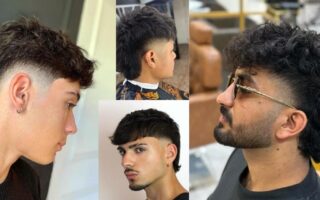
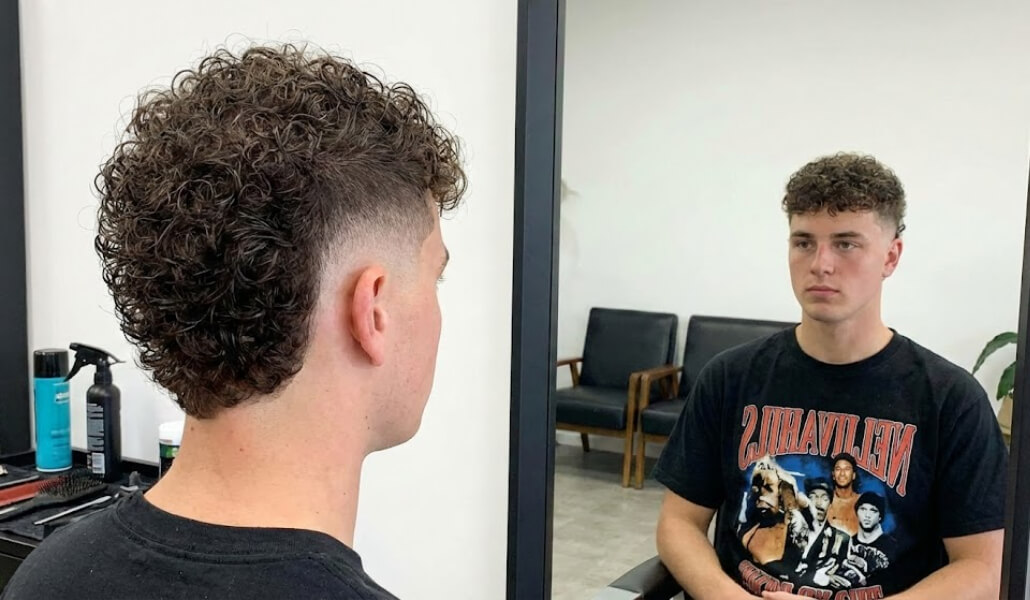
A perm mullet fade looks incredible when it is done right. Defined curls on top, a sharp fade on the sides, and length at the back that moves when you walk. The flip side is that every small mistake shows very clearly, because you are mixing chemical texture with precision clipper work.
This guide walks you through the main mistakes people make with a perm mullet fade and how to avoid them, so your cut supports your main permed mullet look instead of fighting it.
Quick recap: what is a perm mullet fade?
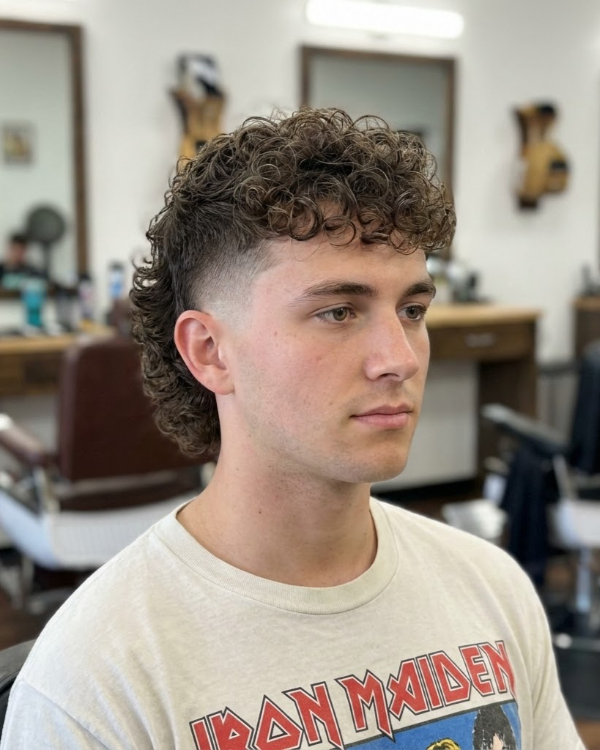
A perm mullet fade is a modern mullet where:
- The top and back are permed to create waves or curls.
- The sides are faded with clippers, from skin or very short up into the longer hair.
- The back keeps some length so it still reads as a mullet, not just a curly fade.
It sits in the middle of three things at once: a perm, a mullet and a fade. That is why precision and planning matter so much.
Why small mistakes show more on a perm mullet fade
With a normal fade, hair grows out quite smoothly. With a normal perm, you can hide a lot of flaws in the volume.
On a perm mullet fade:
- Uneven curls make the silhouette look patchy.
- A bad blend between the fade and perm makes the sides look “stuck on” rather than seamless.
- Wrong fade height or length at the back can make your head shape look off.
Think of it like this: the sharper the cut, the less room there is for guesswork. That is why avoiding the common mistakes below is so important.
Mistake 1: Treating it like a regular perm
The biggest mistake is thinking “a perm is a perm.” A perm mullet fade is not the same as a full head perm.
If your stylist uses the same rod size and technique as a classic tight perm, you can end up with:
- Curls that are too tight for a mullet shape.
- Volume that fights the fade and makes the top look like a helmet.
How to avoid it:
- Tell your stylist you want a mullet with movement, not tight curls all over.
- Ask for a looser, more modern curl pattern, often with larger rods or mixed sizes.
- Show photo references of permed mullets, not just generic perms.
Mistake 2: Choosing the wrong fade height for your head and face
Fade placement changes everything. With a perm on top, the wrong fade height can:
- Make a round face look even rounder.
- Make a long face look too tall and narrow.
- Kill the mullet feel if the fade climbs too high into the back.
How to avoid it:
- For round or wide faces, a mid fade often balances better than an ultra high fade.
- For long or narrow faces, keep a little more weight on the sides so the head does not look too long.
- Ask your barber to keep enough length around the crown and back so it still reads as a mullet, not just a curly top fade.
Mistake 3: Over-processing the hair
Perm solution plus bleach, plus high heat styling equals a fast route to dry, frizzy curls that will not hold a defined shape.
Common over-processing mistakes:
- Perming hair that was lightened recently, without a proper test strand.
- Leaving the solution on too long “to get a stronger curl.”
- Perming hair that is already fragile from box dye or home bleaching.
How to avoid it:
- Always be honest about your hair history. Tell your stylist about every bleach, color, and straightening treatment.
- Be open if your stylist says you need a gentler curl or a conditioning phase before perming.
- Focus on hair health first. A mullet fade with healthy waves looks better than a damaged tight curl pattern.
Mistake 4: Not blending the fade into the permed length
A perm mullet fade should move from:
Skin or stubble → short clipper length → scissor work → permed curls.
If the steps between these are not smooth, you will see:
- A clear ridge line where the clippers stop and the curls start.
- Side profiles that look choppy instead of fluid.
How to avoid it:
- Ask your barber to take extra time on the transition zone, not just the shortest part of the fade.
- They should shape the permed area with scissors and texturizing techniques after the perm, not before only.
- If you have strong, tight curls, the blend needs more careful point cutting so the curls sit into the fade instead of hanging over it.
Mistake 5: Ignoring curl pattern, rod size and sectioning
Not every perm mullet fade needs the same curl. Using the wrong technique can give you curls that:
- Sit in awkward clumps instead of a soft, shaggy texture.
- Shrink too much and eat into your face length.
How to avoid it:
- Match rod size to your natural hair:
- Fine hair often needs a smaller rod for visible curls.
- Thick hair usually looks best with medium rods for a relaxed wave.
- Ask your stylist to perm in a way that supports the mullet shape: more movement through the crown and back, slightly softer on the fringe so it is wearable.
- Avoid perfectly even “roller-set style” curls. A mullet looks better with lived-in, irregular texture.
Mistake 6: Going too short on the sides too soon
You might be tempted to ask for the tightest skin fade possible. The problem is that with a perm on top and length at the back, a very high, tight fade can:
- Make the top look like a wig sitting on the head.
- Remove too much support for the curls, so the shape collapses when they relax.
How to avoid it:
- On your first perm mullet fade, play it safe with a low or mid skin fade rather than a super aggressive high fade.
- Once you see how your curls settle after a few weeks, you can tighten the fade in the next visit if you still want more contrast.
Mistake 7: Skipping a proper consultation
Another very common mistake is booking a “perm” and then trying to explain the whole mullet fade idea in the chair in five minutes. That usually leads to shortcuts and assumptions.
How to avoid it:
- Book a consultation if your barber and stylist are different people. They may need to coordinate cut and perm steps.
- Bring clear reference photos: one for curl type, one for mullet length, one for fade style.
- Be clear about your lifestyle, dress code and maintenance level. A heavy rockstar mullet may not work if you need a cleaner look for work.
Mistake 8: Expecting low maintenance
A perm mullet fade is not a “set and forget” style. If you treat it like one, it will quickly slide into messy, uneven territory.
Common low-maintenance mistakes:
- Not booking regular fade clean-ups.
- Letting the back grow without shaping, so it looks stringy instead of intentional.
- Not trimming the ends of permed hair, so split ends ruin the curl pattern.
How to avoid it:
- Plan on a fade refresh every 2 to 4 weeks, depending on how fast your hair grows.
- Get light shaping on the back and ends every second visit to keep the mullet looking purposeful.
- Work this into your budget and schedule before you commit to the style.
Mistake 9: Using the wrong products on permed curls
You can have the best perm and fade, but if you use harsh shampoo and stiff gel, your curls will look dry and crunchy.
How to avoid it:
- Switch to a sulfate-free shampoo that is gentle on permed hair.
- Use a lightweight curl cream or mousse instead of heavy waxes that weigh curls down.
- Apply a leave-in conditioner or curl balm on damp hair, then diffuse or air dry without touching the curls too much.
- Avoid high-heat tools without heat protection. Repeated hot iron use will relax and roughen the perm.
Mistake 10: Not planning for grow-out and future perms
A perm mullet fade looks its best in the first two months, but you should also think about month three, four and five.
If you do not plan:
- New straight growth will sit under the permed lengths and change the shape.
- The fade will grow into a blunt block of hair on the sides.
How to avoid it:
- Talk to your stylist about when to re-perm, usually once your new growth is long enough and the hair is still healthy.
- Decide if you want to keep the same shape or slowly change it into another look, like a taper mullet or a curly shag.
- Ask them to cut in a way that allows for flexible grow-out, not a shape that only looks good for three weeks.
Mistake 11: Copying celebrity photos without adapting them
A lot of people walk in with a photo of a celebrity perm mullet and say, “Just do this.” The issue is that your hair, face shape and lifestyle may be completely different.
How to avoid it:
- Use celebrity photos as inspiration, not a strict blueprint.
- Ask your stylist: “What parts of this cut work with my hair, and what should we adjust?”
- Focus on elements you like, such as the curl looseness, the length at the back, or the strength of the fade, and customise the rest.
How to set yourself up for a great perm mullet fade
To support your main permed mullet look and avoid the usual problems, use this checklist before you commit:
- You understand the maintenance: regular fade clean-ups and product care.
- Your hair is healthy enough for a perm.
- You have chosen a fade height that works with your face shape and lifestyle.
- Your stylist knows you want a mullet shape, not just a generic curly perm.
- You have realistic photo references that match your hair type.
When you get these details right, a perm mullet fade becomes a powerful supporting style, not a risky experiment. It frames your curls, sharpens your outline, and makes the whole permed mullet story look deliberate and high level instead of random.
Ready to take your perm mullet fade from good to standout? Bring this guide to your next appointment and talk through each point with your stylist so your cut grows better, lasts longer and looks intentionally styled every day.