There is a unique, dizzying anxiety that hits the moment you hear clippers echoing in your bathroom. Shaving your head is a bold leap of faith where your scalp becomes the main event, and every angle is suddenly on display.
I remember a client, Mark, who stood exactly like that before his wedding. He was losing his hair to male pattern baldness and wanted to take control, but was terrified he would look like a prison-movie extra. For weeks, he furiously searched what face shape is best for buzz cut, scrolling forums at 2 a.m., convinced the answer would decide his fate.
When we finally buzzed it down, his entire visual presence changed. A buzz cut strips away the safety net—the curls that hide bumps, the fringe that masks a high forehead, the volume that fakes a strong jawline.
You are left with raw, unadulterated geometry. So, how do you know if your geometry can handle the exposure?
TL; DR: Which Face Shapes Win (and Lose) With a Buzz Cut?
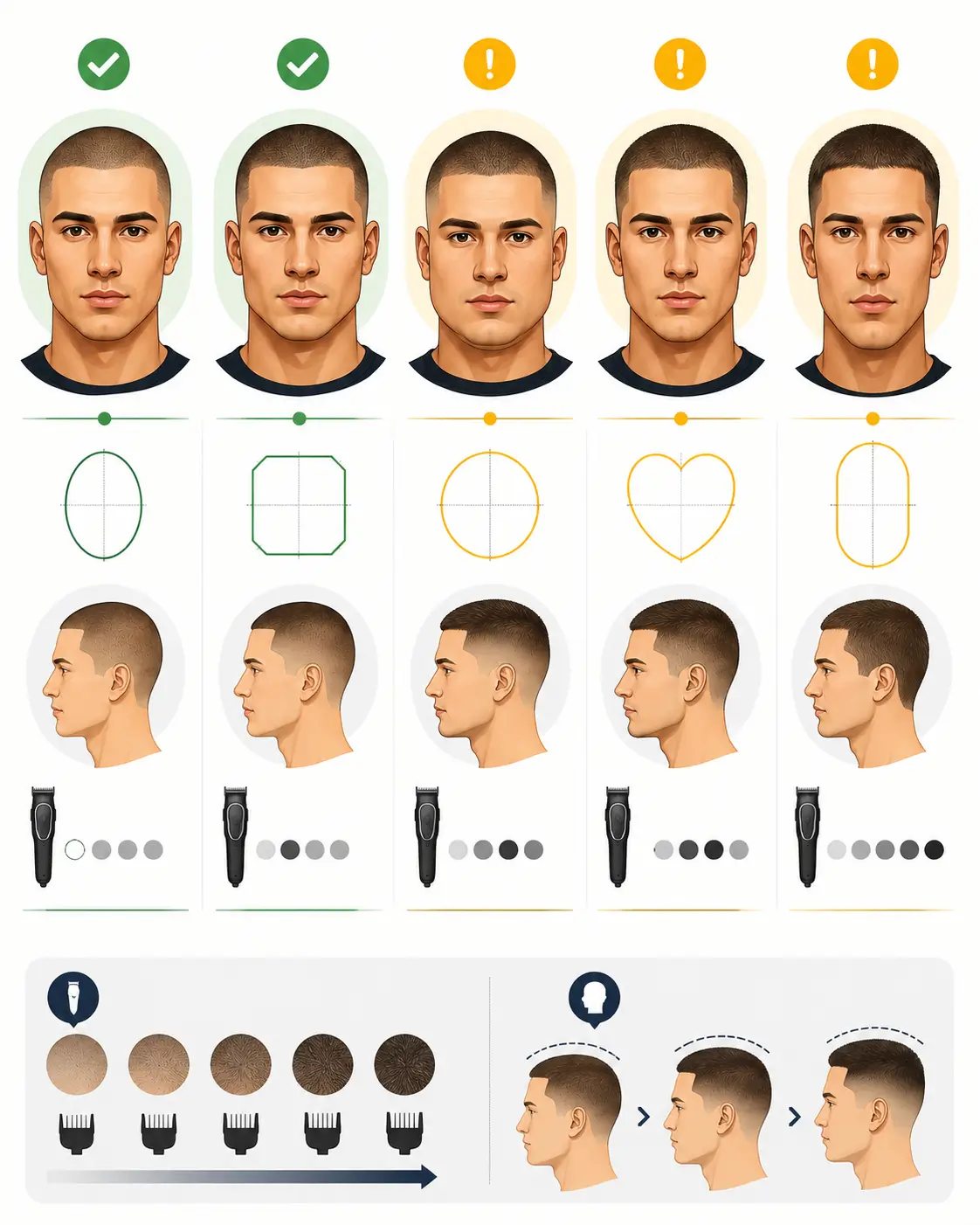
Oval faces are the universal winners; they can pull off any buzz cut length, from a skin-tight induction cut to a fuller butch cut.
Square faces are tied for first place, as the buzz cut highlights their natural, rugged jawline.
Round faces face an uphill battle, as the cut can emphasize width unless faded correctly.
Heart-shaped faces risk looking top-heavy, requiring careful length management through the crown and temples.
Oblong faces often struggle, as the lack of hair can make the face appear excessively long.
But to truly understand why these rules exist, we need to look at the architecture of your skull.
The Visual Science: How Hair Actually Frames Your Face
Think of your hair as the picture frame and your face as the artwork inside it. When you have a full head of hair, that frame creates optical illusions—it can add width to a narrow face, soften a harsh jawline, or balance a prominent nose.
A buzz cut effectively smashes the frame. You are left with just the canvas, meaning the proportions of your skull and facial features are suddenly thrown into stark relief.
Visual balance relies on symmetry and geometric harmony. If your face is wide, a buzz cut makes it look wider because there is no hair to break the horizontal line at the parietal ridge—the bony ridge along the upper sides of your head, about three finger-widths above your ears, and the widest part of your skull.
If your face is long, removing hair from the top of your head removes visual weight, making your face look even longer. This is why a guard—the plastic attachment on your clippers that determines how much hair stays—is your most critical tool.
Understanding your face shape tells you exactly which guard number you need to fake perfect balance.
Face Shape Breakdown: Who Suits the Buzz Cut?
Every skull is built differently, and the buzz cut is unforgiving of imbalances. Here is exactly how the five main face shapes interact with the clippers.
Oval: The Golden Ratio

The oval face shape is roughly one and a half times longer than it is wide, with a slightly curved jawline narrower than the cheekbones.
Because the proportions are already naturally balanced, the oval face wins the buzz cut lottery. You can confidently take your clippers straight down the middle with a #2 guard (about 1/4 inch or 6mm) and walk out the door looking like a model.
There is no need to compensate for extreme angles or excessive length. Even a uniform burr cut—the classic #1 or #2 all-over crop with a slightly abrasive, sandpaper-like texture—looks intentional on an oval face.
Square: The Rugged Ideal
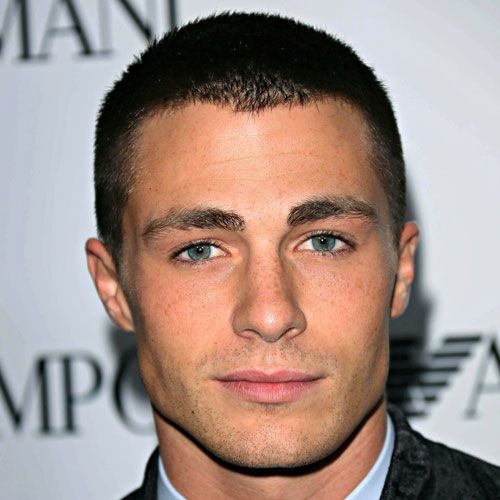
A square face shape features a strong, angular jawline with forehead, cheekbones, and jaw all roughly the same width.
The buzz cut was practically invented for the square face. Going ultra-short with a #1 guard (1/8 inch or 3mm) highlights the bone structure and creates a striking, military aesthetic. This near-bald shear, traditionally known as an induction cut, leaves the scalp visible through the hair—ideal for showing off sharp, masculine angles.
If you want to soften the harshness slightly, a #3 guard (3/8 inch or 9mm) adds just enough shadow to round out the sharpest corners, edging into butch cut territory.
Round: The Angular Challenge
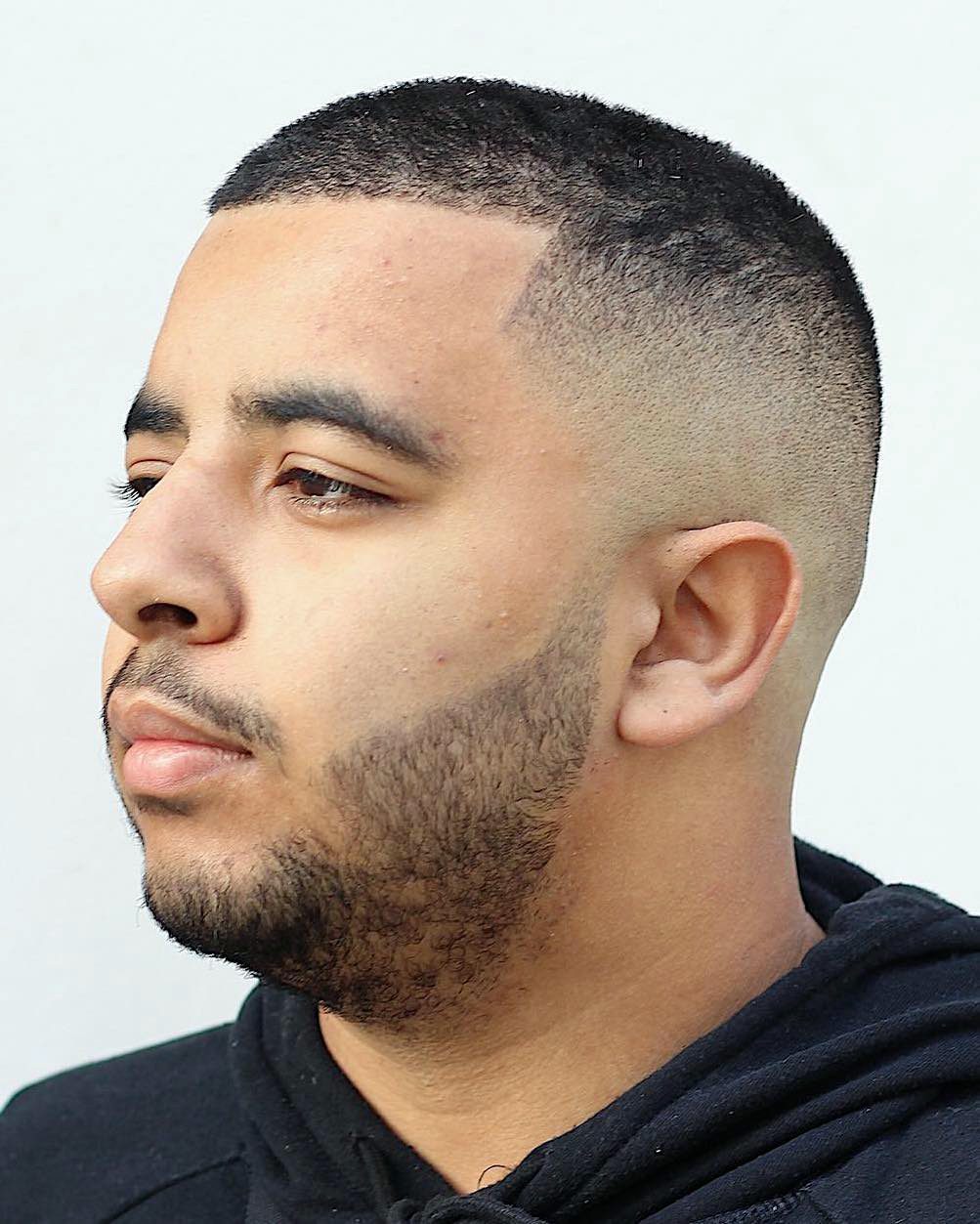
A round face shape has soft curves, full cheeks, and a width nearly equal to its length. The goal here is to create the illusion of angles and height.
Buzzing a round face uniformly can result in a cantaloupe effect, making the head look like a smooth sphere. Avoid cutting all your hair to one length.
Instead, use a #4 guard (1/2 inch or 12mm) on top to add vertical height through the crown, and drop down to a #1 guard (3mm) on the sides. This contrast creates a fade—a gradual transition from short to long hair that visually slims the cheeks and adds sharp angles where there are none.
A high and tight, with bare sides fading abruptly into a short, cropped top just below the crown, is a strong round-face option.
Heart: The Top-Heavy Dilemma
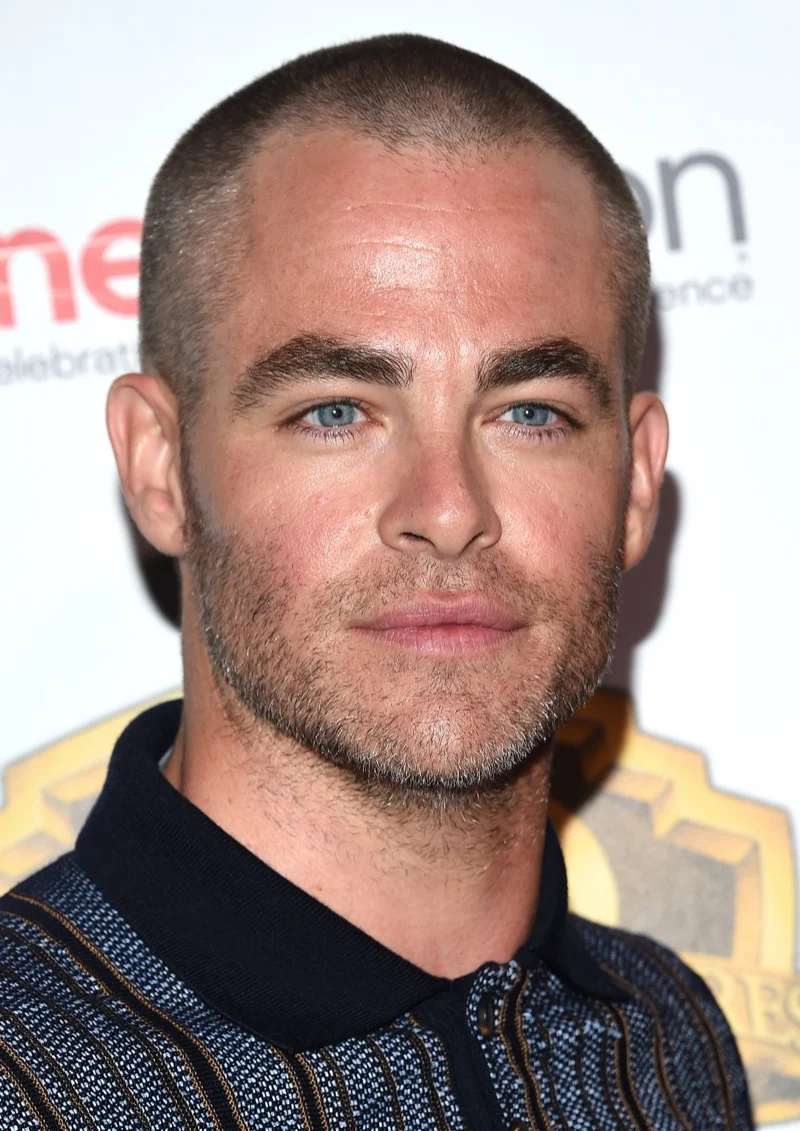
The heart face shape is characterized by a wide forehead and cheekbones that taper down into a narrow, pointed chin.
Taking a heart-shaped face down to a #1 guard (3mm) makes the forehead look massive and the chin look tiny, throwing off the visual balance completely. The temples—those small areas just above and in front of your ears—also get exposed, widening the upper face further.
To survive the buzz, keep a #3 guard (9mm) all over. This longer length casts a slight shadow on the forehead, reducing its visual weight and bringing harmony to the pointed chin.
Oblong: The Length Problem
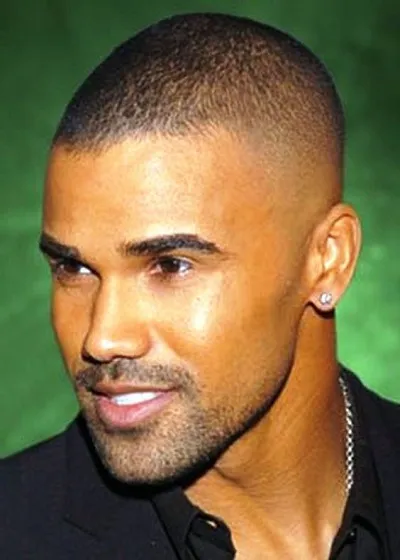
An oblong face shape is significantly longer than it is wide, often with a prominent chin. The primary geometric goal is to avoid making the face look like a vertical rectangle.
Removing hair from the top of an oblong face eliminates the visual breakers that stop the eye from traveling downward. A uniform buzz cut will make your face look alarmingly long.
If you must buzz, stick strictly to a #4 guard (12mm) everywhere to retain maximum shadow and width at the parietal ridge. Avoid the ultra-short cuts that elongate the skull, and skip the crew cut with its extra fringe up top, which only adds unwanted height.
Now that we know who can wear the cut, let us dismantle some of the toxic myths keeping men from the clippers.
Common Buzz Cut Myths
The internet is full of terrible advice regarding who is “allowed” to shave their head. Let us clear the air with geometric facts.
Myth: You need perfect facial features.
This is entirely false. A buzz cut does not require perfect eyes, a straight nose, or flawless skin—it requires a balanced skull shape. Features only look “off” when the haircut creates a visual imbalance, like shaving a round face into a sphere.
Myth: If you are balding, a buzz cut is your only option.
While buzzing thinning hair is a confident move, it is not mandatory. However, whether you are dealing with a receding hairline, a widow’s peak (that V-shaped point at the center of the forehead), or a thinning crown, a uniform #2 guard (6mm) cut minimizes the contrast between your hair and your scalp.
The buzz cut is actually one of the most barber-recommended choices for hair loss because it reduces the appearance of low hair density without looking like a comb-over.
Myth: Buzz cuts make your head look bigger.
They do not make your head bigger; they reveal its true size. Hair often adds false volume. If your head looks larger after a buzz cut, it is simply because you removed the optical illusion.
Understanding these myths is crucial before you plug in the clippers. But knowing the myths is only half the battle—you also need to avoid the mechanical errors that ruin home buzz cuts.
Common Mistakes When Buzzing at Home
Grabbing the clippers without a plan is a recipe for a week of wearing hats. Here are the most frequent errors I see in the chair.
Mistake: Ignoring ear size.
If you have prominent ears, taking the sides down to a #1 guard (3mm) will make them stand out like satellite dishes. Always leave a #3 guard (9mm) on the sides if your ears are large to cast a shadow that minimizes their visual footprint.
Mistake: Using the wrong guard for skull bumps.
Not all skulls are perfectly smooth. If you have a pronounced occipital bone (the bump at the back of your head) or an uneven nape (the lower back area of your neck), a #1 guard will highlight every ridge.
A #2 or #3 guard provides enough coverage to smooth out the visual topography of your scalp.
Mistake: Forgetting the beard boundary and edges.
A buzz cut does not stop at the hairline. If you have a beard, you must blend the hair into the facial hair with a taper—a gradual shortening—at the sideburns.
Use a trimmer (the smaller, finer-bladed tool designed for detail work) rather than your clippers (the larger tool built for bulk cutting with guards) to carve a sharp line up around the temples and a clean neckline at the nape. This keeps the cut looking fresh and deliberate rather than overgrown.
To avoid these mistakes entirely, you need to know exactly what you are working with. Let us figure out your face shape right now.
Actionable Guide: How to Determine Your Face Shape at Home
You do not need a stylist to measure your face. You just need a flexible tape measure, a mirror, and two minutes.
Step 1: Measure your forehead.
Run the tape across the widest part of your forehead, usually halfway between your eyebrows and your hairline.
Step 2: Measure your cheekbones.
Measure across the highest points of your cheekbones, just below the outer corners of your eyes.
Step 3: Measure your jawline.
Measure from the tip of your chin to the point below your ear where your jaw angles upward, then multiply by two.
Step 4: Measure your face length.
Measure from the center of your hairline straight down to the lowest point of your chin.
Step 5: Compare the numbers.
You have an oval face if your length is slightly greater than your width, paired with a soft jaw. A square shape occurs when your measurements are similar and your jaw is sharp. Round faces, meanwhile, feature nearly equal length and width with soft curves. If your forehead is your widest feature and tapers to a pointed chin, you have a heart-shaped face. Finally, an oblong face is one where the length is significantly larger than the width.
Key Takeaways & Conclusion
The buzz cut is the ultimate test of geometric confidence. It strips away the illusions we use to hide behind our hair and forces us to rely on pure bone structure.
Oval and Square faces can confidently reach for the #1 and #2 guards (3mm–6mm), embracing everything from an induction cut to a burr cut. If you are Round, Heart, or Oblong, use #3 and #4 guards (9mm–12mm) to manipulate shadows, fake angles, and restore visual balance.
Never ignore your ears, your occipital bone, or your parietal ridge when choosing your final length. And always finish with a trimmer line up and a clean neckline for a deliberate, professional finish.
Do your measurements, pick the right guard, and take control of the clippers—the geometry is already on your side.