
The mullet looked incredible leaving the chair. Two days later? Flat on top, poofy at the sides, and somewhere between “intentional edge” and “forgot to shower.” If that sounds familiar, the problem almost certainly isn’t your barber, your hair type, or the product you grabbed off the shelf. The problem is that almost everyone obsesses over the wrong variable: length, when the entire personality of a modern mullet lives in its shape.
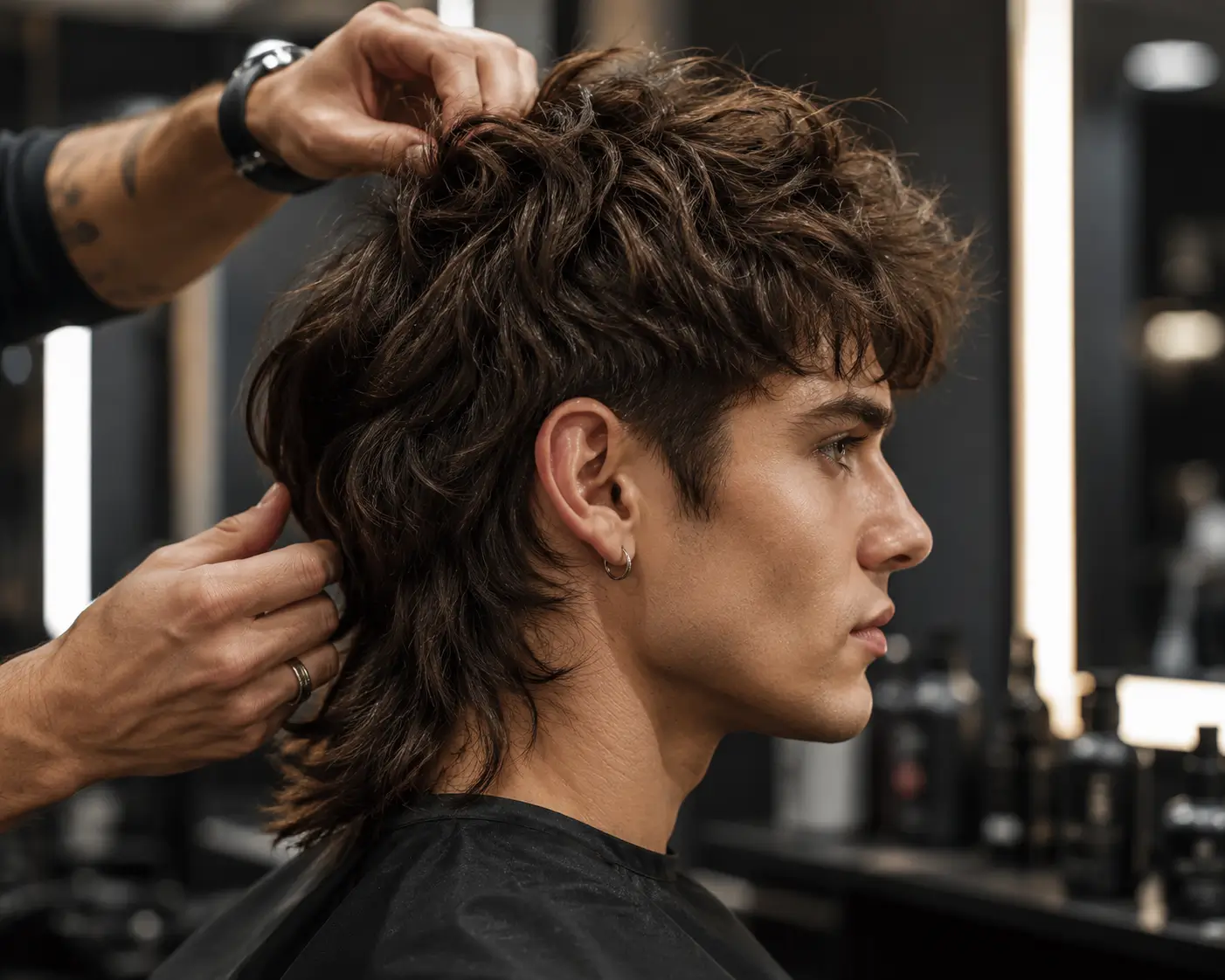
A Scene That Plays Out Every Week
Picture this. Someone walks into a salon clutching a screenshot of a celebrity rocking a perfectly tousled modern mullet. They’ve memorized the brief: short sides, longer back. The stylist follows the brief, the inches come off in all the right places, and the mirror looks great under the salon lights.
Then Monday morning happens. The crown has gone flat. The back has collapsed into a dense, heavy block. The sides stick out at an angle that reads more “electrocuted” than “editorial.” The cut technically matches the reference photo on every measurement — yet it looks nothing like it.
This happens because a modern mullet isn’t a measurement. It’s an architecture. And understanding why it collapses requires a quick trip into the physics of hair.
Why This Happens: The Physics, Explained Simply
Hair movement isn’t random. It’s guided by four forces: gravity, weight distribution, elasticity, and tension. Stylists who understand these principles can engineer haircuts that move fluidly rather than just hang there.
Here’s the key insight: dense, heavy hair moves less freely, while lighter hair floats and shifts. By strategically removing weight through internal layering, a stylist redistributes mass and encourages bounce and natural swing.
The Physics of the Pyramid Effect:
When you only focus on length: Occipital bone curves outward + Hair pushed away from scalp + Bulk piles at back = PYRAMID EFFECT (short layers push long layers up)
When you focus on shape (internal layering): Removes crown weight + Mass redistributed = Distributed volume (crown lift + mid-back texture + tapered ends)
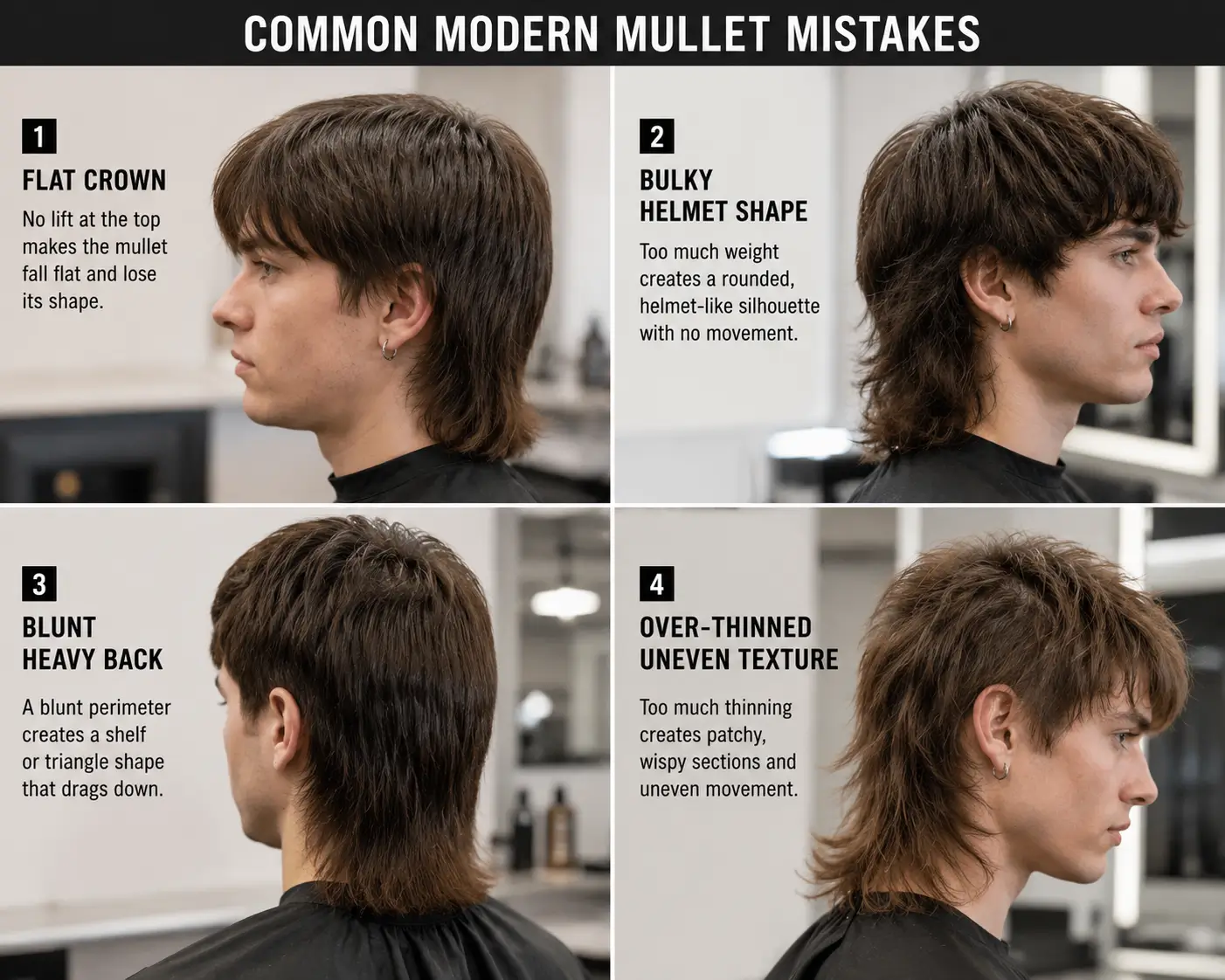
The back of the human head — the occipital bone — curves outward. When you leave the back long without touching the internal structure, gravity pulls that mass straight down and outward, away from the curve of the skull. The shortest layers at the top push the longer layers up from underneath. The result is the dreaded “pyramid” or “shelf” — a triangular silhouette that has nothing to do with how many inches were left in the back.
As one barber education resource puts it plainly: “Too much bulk at the crown creates mushroom vibes. Too much at the back creates a tail that drags. The goal is distributed volume: enough at the crown to maintain lift, enough through the mid-back for texture, and tapered ends that don’t look heavy.”
So, when someone says “shape,” what they really mean is where the weight sits.
The Wet-Hair Problem: A Quick Detour into Bond Chemistry
There’s a second piece of science that explains why so many mullets go wrong before they even leave the salon. Hair is held together by several types of bonds, and the weakest — hydrogen bonds — are temporarily disrupted simply by water exposure. They reform as hair dries, which is exactly why wet setting can temporarily reshape hair. Hydrogen bonds account for roughly 35% of hair’s total strength but offer no permanent structural stability.
This matters because wet hair physically stretches. As stylist educator Laura Collins explains, “the hair strands actually stretch when they’re wet and combed down,” and curly hair can shrink significantly — sometimes 50% or more — as it dries. A heavily layered shape cut wet will shift and shrink unpredictably as it dries.
More importantly for the mullet: you cannot properly texturize wet hair. Texturizing is the process of removing bulk to reduce weight lines and add movement, and it requires seeing how the hair naturally lays. “When the hair is dry, the weight lines become visible,” Collins notes — which is why she insists the hair always needs to be checked dry after a wet cut.
Myths That Keep Mullets Mediocre
- Myth #1: “A mullet is just a grown-out pixie.” Not quite. A true modern mullet is an intentional, precision cut built on blended layers, textured ends, and gradual fades that make the silhouette feel deliberate rather than accidental.
- Myth #2: “You need thick hair to pull it off.” The opposite is often true. The modern mullet is built on removing bulk and creating texture. For fine hair, steep layering at the crown can manufacture the illusion of density — though it does demand more daily effort and lighter products.
- Myth #3: “The blunter the back, the better.” This is the fast track to a rat tail. The modern mullet relies on soft, diffused perimeter lines, not hard blocks.
The Mistakes People Actually Make
- Mistake #1: Focusing on inches over silhouette. The most common error is walking in with a celebrity reference photo and only discussing length. As one barber guide bluntly advises: “Skip the celebrity reference photo. Instead, tell them what you need the cut to do.”
- Mistake #2: Over-texturizing with thinning shears. Thinning shears are designed to remove bulk and weight so hair has lift and movement — but used incorrectly, they create visible lines and chunky holes rather than soft texture. Aggressive razor work on dry hair can also split the cuticle and cause frizz.
- Mistake #3: Ignoring hair type. Thick, straight hair often becomes a “helmet mullet” that sits heavy and flat. Fine, straight hair demands manufactured texture that won’t naturally hold. Curly hair needs a completely different approach — managing curl pattern, not creating texture from scratch.
Best Solutions: Talk About Silhouette, Not Inches
The fix starts with vocabulary. Ask your stylist to remove weight from the crown so the top blends smoothly into the back. Request point cutting — a technique that strategically removes weight and adds movement by cutting into the ends vertically rather than straight across. Or ask for slide cutting, where scissors glide along the hair shaft to remove weight and add texture without blunt lines.
Crucially, request that the shape be checked and refined dry. This is when weight lines become visible and the true silhouette reveals itself. Many top mullet tutorials now combine wet and dry cutting — wet for the initial structure, dry for the texturizing and detailing that defines the modern look.
A Step-by-Step Routine That Protects the Shape
- Wash with lightweight moisture. Heavy, oil-rich products weigh down the crown and kill the volume the shape depends on. Volumizing or lightweight formulas are your friend.
- Apply texture product to damp hair. A sea salt spray adds grit and movement; a matte clay or texture paste gives hold without shine or weight.
- Build root lift at the crown. This is the highest point of the cut and needs elevation to maintain the silhouette. A small amount of mousse or volume spray at the roots does the work.
- Air dry or diffuse on low. Avoid aggressively flattening the top with a round brush. Scrunch gently and let natural texture do its thing, or use a diffuser on low heat.
- Piece out the back with a styling cream. A pea-sized amount smoothed over the longer back lengths defines movement without greasing up the shorter layers.
- Maintain the shape, not the length. Book a trim every 6 to 8 weeks. Regular trimming keeps style lines fresh so the hair falls into place, removes split ends before they travel up the shaft, and preserves the architecture that makes the cut work. Tell your stylist you want the perimeter dusted but the internal layers re-texturized — because as hair grows, the shape distorts even when the inches are unchanged.
Key Takeaways
- Length is the material; shape is the architecture. A mullet lives or dies on weight distribution, not inches.
- The pyramid effect comes from leaving bulk at the back without internal layering to redistribute it.
- Hydrogen bonds make wet hair stretch and shrink unpredictably — which is why heavily layered shapes must be checked and refined dry.
- Point cutting and slide cutting are the techniques that create movement; blunt trims create blocks.
- Talk to your stylist about where the weight sits, not how long the back should be.
- Trim every 6–8 weeks to preserve the silhouette as it grows.
The Bottom Line
A modern mullet is less a hairstyle and more a small engineering project. The back length is just the raw material; the layers, the weight removal, the fade placement, and the texturizing are what turn that material into something that moves, lifts, and holds its shape past Monday morning.
If you’re considering one, stop measuring the back and start asking about the silhouette. Because in the end, it’s never the inches that make a mullet look intentional — it’s the geometry underneath.