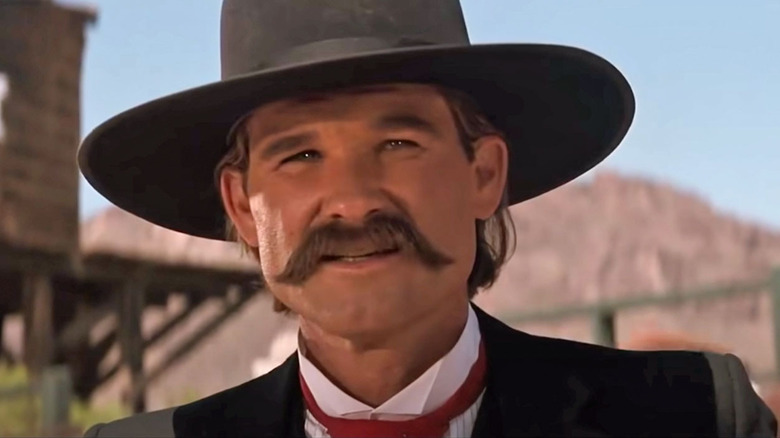
Yes. Kurt Russell’s mustache in Tombstone was real. In fact, the production leaned hard into authenticity. Reports from cast interviews and film notes indicate that nearly every major mustache you see was grown by the actors, with Jon Tenney (Sheriff Johnny Behan) being the notable exception because he could not grow one in time for the shoot and wore a fake instead.
That single detail might sound like trivia, but it helps explain why Tombstone still feels so tactile and lived-in. The facial hair looks like it belongs to men who ride, fight, sweat, and live outdoors, not characters who just stepped out of wardrobe for the day.
Why Wyatt Earp’s Mustache Became a Legend
Wyatt Earp’s real-life image is tied to late 19th-century facial-hair culture, where mustaches were not just fashion, but status. Many historical depictions show him wearing a bold, structured style that sits somewhere between a handlebar and a heavier, more sweeping Western variant. Modern grooming writers often associate Earp with the handlebar family of mustaches.
A handlebar is defined by length and upward-curving ends, usually trained with wax. By the time the movie lands in the period around Tombstone and the O.K. Corral era, the goal was not to make everyone look like a modern barbershop poster. The goal was to make the men look like they belonged to that decade, that town, and that level of danger.
The “Tombstone Mustache Rule”
Behind the scenes, Tombstone had a simple but firm grooming culture. According to recollections tied to actor Michael Biehn, the film’s original director and writer Kevin Jarre preferred mustaches that could be curled at the ends, which effectively nudged the cast toward growing their own and learning to shape them.
That rule did two things:
- It created a consistent, period-leaning look across the cast.
- It turned mustaches into a subtle signal of masculinity and rank on set, which amusingly left Tenney as the odd man out with a removable fake.
The Kurt Russell Version: What You’re Really Seeing
Russell’s mustache as Wyatt Earp is not a tiny, neat handlebar. It is a bigger Western statement.
Key traits:
- Thick density through the center.
- Wide coverage that extends past the corners of the mouth.
- Downward sweep with the suggestion of controlled ends, rather than tight modern curls.
- A bridge style that feels part walrus, part handlebar, which suits Earp’s tough, grounded presence.
This hybrid look is likely why it reads as both intimidating and iconic on screen.
How to Get the Tombstone Wyatt Earp Mustache
You can absolutely pull this off today without looking like you are wearing a costume, as long as you keep the shape authentic and pair it with a balanced haircut.
1. Commit to the grow-out
For most people, this style needs time and patience. You want enough length that the mustache can sweep past the corners of your mouth. A rough range is 6 to 10 weeks of solid growth for many men, sometimes longer depending on genetics.
During this phase:
- Avoid over-trimming the body.
- Only clean the neckline and stray hairs that distract from the main shape.
2. Start training early
Training is what separates a lived-in Western mustache from a messy one.
- Comb the hair outward daily.
- After showering, gently direct the ends toward the shape you want.
- Use a small amount of product to set the direction.
3. Use mustache wax, not hair gel
The classic handlebar tradition relies on wax for control and curl. That same principle applies here, even if you are aiming for a softer Earp-style sweep.
How to apply:
- Warm a tiny amount between your fingers.
- Work it lightly from the center out.
- Focus on the ends for structure.
- Shape with fingers or a small comb.
4. Shape for “bold, not cartoon”
This is the secret.
The Tombstone version is:
- Less stylized than modern competitive handlebar looks.
- More rugged and weighty.
Aim for:
- A strong central body.
- Ends that lift slightly or hold a gentle curve.
- No extreme twirls unless you are going for a themed event.
5. Keep the lip line clean
To avoid eating half your mustache with every meal:
- Trim just the hair that drops over your upper lip.
- Keep the line natural, not razor-straight.
6. Pair it with the right haircut
Earp’s overall look in Tombstone is restrained Western authority.
A good modern match:
- Medium length on top.
- A classic side part or brushed-back shape.
- A soft taper rather than a high-contrast skin fade.
You want the mustache to be the focal point, not competing with an aggressive modern cut.
What to Wear With It So It Looks Modern
If you want the vibe without the full cowboy uniform:
- Stick to neutral tones.
- Use structured basics like a dark jacket, clean boots, and simple shirts.
- The mustache will do most of the storytelling.
Common Mistakes That Ruin the Look
A few small errors can turn iconic into awkward.
- Over-trimming too early
You will never get the Earp sweep if you keep resetting it to a short, neat line. - Using too much wax
The mustache should look strong and real, not glossy and stiff. - Forcing a tight handlebar
Wyatt Earp’s vibe is controlled authority, not modern novelty. - Ignoring face shape balance
A large mustache needs a clean outline elsewhere. Keep your cheeks, jawline, or beard edges tidy.
Real vs. Movie-Perfect Expectations
It is worth remembering that Tombstone benefited from:
- professional grooming,
- consistent daily maintenance,
- and style direction anchored to period logic.
So if your version ends up slightly less dramatic, that is fine. The goal is the spirit of the look: confident, classic, and unapologetically bold.
The Bottom Line
Kurt Russell’s mustache in Tombstone was real, and the film’s commitment to authentic facial hair is part of why the characters feel so believable, with only one notable fake among the main mustaches. The style itself draws from late 19th-century traditions associated with figures like Wyatt Earp and handlebar-era grooming culture.
If you want the look today, focus on length, training, and light wax control. Keep the shape bold but grounded, pair it with a classic haircut, and you will land in that sweet spot where the mustache feels historic-inspired without feeling like a costume.