Quick answer for readers in a hurry:
The Billy Ray Cyrus mullet became iconic by blending country tradition with pop accessibility in the early 90s. It faded due to a shift toward minimalist grooming but returned in the 2020s as a symbol of irony and confidence, modernized with fades and natural texture.
This hairstyle was one of several defining looks from the decade. For a broader look at how mullets evolved across music, sports, and pop culture, see our complete guide to 90s mullet hairstyles.
This article explains:
- What made Billy Ray Cyrus’s mullet different
- Why it dominated pop culture
- Why it became controversial
- How it evolved in the modern era
- Whether (and how) it works today
Who Made the Mullet a Cultural Icon?
Mullets existed long before the 1990s, but Billy Ray Cyrus transformed the hairstyle into a mainstream cultural symbol.
His rise coincided with the explosive success of Achy Breaky Heart, a track that arrived at a pivotal moment in American entertainment. Country music was expanding beyond its traditional audience, MTV was still a dominant force, and visual branding had become inseparable from commercial success.
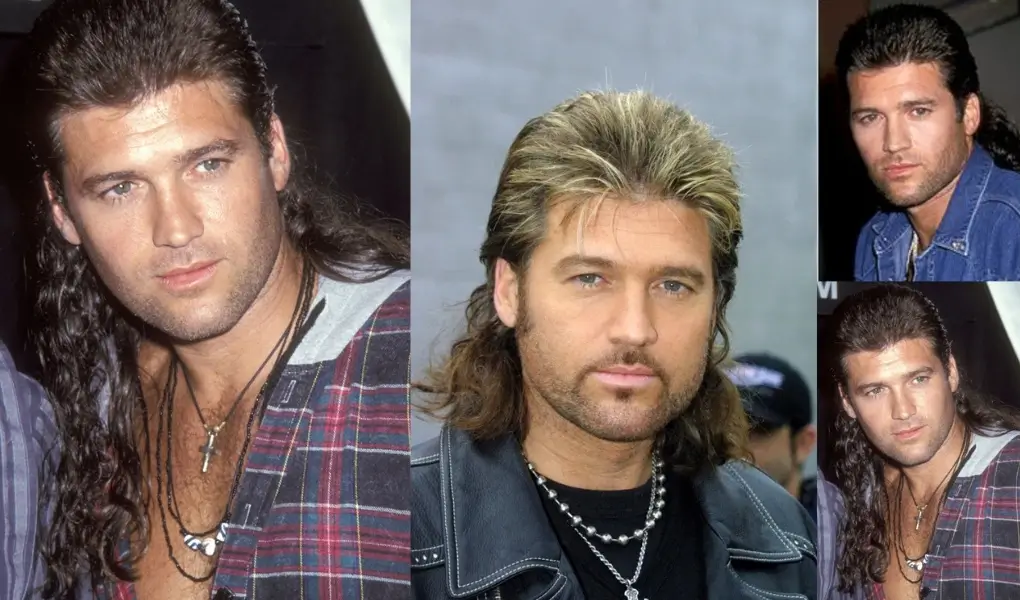
Cyrus’s haircut was not a background detail. It was a deliberate part of his public identity. The mullet made him instantly recognizable in music videos, television appearances, album art, and live performances. In a crowded media landscape, that recognizability mattered.
Why Was Billy Ray Cyrus’s Mullet Different From Other Mullets?
Many celebrities wore mullets, but Cyrus’s version achieved something rare: cultural saturation without losing coherence.
1. It Was Deliberately Designed
This was not an overgrown haircut or a rebellious accident. The structure was precise. The contrast between short and long sections was intentional, balanced, and repeatable—important qualities for a look meant to scale across mass media.
2. It Balanced Tradition and Rebellion
The mullet communicated two opposing messages at once:
- The front and sides suggested discipline and approachability
- The back signaled individuality and defiance
That duality mirrored early-1990s country-pop itself: traditional roots presented through a modern, commercial lens.
3. It Was Optimized for the Media Era
In the age of broadcast television and music videos, silhouettes mattered. Cyrus’s mullet read clearly on camera, under stage lighting, and even in low-resolution formats. It functioned as visual shorthand.
What Exactly Is the Billy Ray Cyrus Mullet?
Understanding the haircut requires breaking it down structurally.
The Front: “Business”
- Short, feathered bangs
- Styled with lift and volume
- Framed the face cleanly for television and print
This ensured the hairstyle remained socially acceptable and professional-looking from the front.
The Sides: Controlled Contrast
- Tapered or closely cropped
- Reduced bulk around the ears
- Emphasized the transition to the back
The sides were critical. Without restraint here, the mullet loses definition.
The Back: “Party”
- Shoulder-length or longer
- Mostly straight with light wave
- Conditioned for shine and weight
Unlike many 1980s mullets, this version avoided extreme curls or teasing, favoring polish over chaos.
Maintenance Reality
This haircut required upkeep. Regular trims, conditioning, and styling products were necessary. The polished finish communicated intention, which is why it resonated so strongly at the time.
Why Did the Mullet Become Mocked?
By the mid-to-late 1990s, broader aesthetic values shifted. Fashion and grooming moved toward:
- Cleaner lines
- Subtlety
- Minimalism
As the mullet became widespread, it lost its distinctiveness. Overexposure turned it from a bold signal into a visual cliché.
This shift was not unique to hair. It reflected broader cultural changes in:
- Men’s fashion
- Media tone
- Public taste
As Billy Ray Cyrus diversified his career—including later television work such as Hannah Montana—his image evolved accordingly. Moving away from the mullet aligned with changing norms rather than rejecting his past.
What Most Articles Miss About the Billy Ray Cyrus Mullet
This is where deeper context matters.
- It was never intended as irony in the early 1990s
- It required more grooming effort than many “clean” styles
- Its success depended on media amplification, not shock value
- Its decline was about context loss, not inherent ugliness
Understanding these points reframes the mullet as a product of cultural alignment, not poor taste.
Did the Mullet Ever Really Disappear?
No. It entered a referential phase.
During the 2000s, the mullet survived as:
- A comedic symbol
- A nostalgic marker
- A visual shorthand for “the 90s”
This stage preserved its cultural memory. Styles that are truly forgotten do not return; styles that are remembered get reinterpreted.
Why Did the Billy Ray Cyrus Mullet Come Back?
Fashion cycles typically operate on 20–30 year loops. The mullet’s return followed a familiar pattern:
- Rejection
- Irony
- Reinterpretation
The catalyst was Billy Ray Cyrus’s reemergence during the success of Old Town Road.
This moment mattered because:
- It bridged generations
- It blended genres
- It reframed Cyrus as culturally current
The haircut returned not as nostalgia, but as continuity.
How the Modern Cyrus Mullet Is Different
Structural Changes
- Sharp fades replaced soft tapers
- Natural texture replaced sculpted volume
- Grey hair embraced, not concealed
Conceptual Shift
The modern mullet is less about rebellion and more about self-assured visibility. It works when worn without apology or parody.
1992 vs. Modern: A Clear Comparison
| Feature | Early 1990s Version | Modern Interpretation |
|---|---|---|
| Sides | Soft taper | Sharp fade |
| Top | Blow-dried volume | Relaxed texture |
| Back | Glossy, uniform | Slightly rugged |
| Meaning | Country-pop branding | Personal confidence |
Should You Get a Billy Ray Cyrus–Inspired Mullet Today?
Only if it’s modernized and intentional.
This Style Works Best If:
- You’re comfortable standing out
- Your hair has natural texture or wave
- You prefer expressive, non-generic styles
Avoid It If:
- You need conservative professional presentation
- You dislike regular trims and styling
- You expect it to be low-effort
How to Ask for This Cut (Without Sounding Dated)
Use clear, modern language:
“I want a modern mullet with a low drop fade, textured top, and connected length in the back. Natural finish—no shine.”
This communicates structure, not nostalgia.
Styling the Modern Cyrus Mullet
Products
- Matte pomade or texture powder
- Light conditioning treatments
- Avoid wet-look gels
Philosophy
The goal is movement and intention, not polish. Over-styling undermines credibility.
Frequently Asked Questions (FAQ)
1. Was Billy Ray Cyrus the first person to wear a mullet?
No. Mullets existed for decades across rock, sports, and film. Billy Ray Cyrus’s significance lies in popularizing a commercially refined version at a moment when mass media amplification—especially music television—turned personal style into cultural identity.
2. Why did the Billy Ray Cyrus mullet become so famous so quickly?
Because it aligned perfectly with:
- A breakout hit song
- Heavy television rotation
- A shift in country music toward pop audiences
The haircut was instantly recognizable, easy to imitate, and visually distinct—critical factors in pre-social media celebrity branding.
3. Was the mullet meant to be ironic or rebellious?
No. In the early 1990s, the mullet was worn earnestly. It was seen as confident, expressive, and modern within its cultural context. Irony only became attached to the style later, after tastes changed and the haircut became oversaturated.
4. Why did the mullet fall out of fashion in the late 1990s?
The decline was driven by broader aesthetic shifts:
- Minimalist fashion replaced maximalism
- Grooming standards favored subtlety
- Cultural fatigue set in due to overuse
The mullet didn’t become “bad” overnight—it became out of sync with prevailing norms.
5. Why did the mullet come back in the 2010s and 2020s?
Fashion operates in cycles, typically returning every 20–30 years. The mullet’s revival was fueled by:
- Nostalgia paired with reinterpretation
- Rejection of overly polished aesthetics
- Greater acceptance of expressive masculinity
Its return worked because it was updated, not copied.
6. Is a Billy Ray Cyrus–style mullet acceptable today?
It can be—if modernized.
Appropriate today when:
- Sides are faded or tightly cut
- Texture is natural, not glossy
- The wearer projects confidence
Less suitable for:
- Conservative corporate environments
- Situations requiring strict uniformity
Execution and context matter more than the haircut itself.
What the Billy Ray Cyrus Mullet Ultimately Represents
This hairstyle endures because it demonstrates how:
- Style reflects cultural shifts
- Media amplifies aesthetics
- Confidence sustains controversial looks
The mullet is not timeless, but it is resilient.
TL;DR (Too Long; Didn’t Read)
The Billy Ray Cyrus mullet became iconic because it perfectly matched a moment when country music, pop culture, and visual branding collided in the early 1990s. It faded when minimalist grooming trends took over, then returned decades later as fashion cycles, cultural confidence, and reinterpretation made it relevant again. Today, the style only works when modernized—tight sides, natural texture, and intentional execution.
A Haircut That Became Cultural History
The Billy Ray Cyrus mullet is remembered not simply for its boldness, but for its precision, timing, and alignment with a cultural moment. It captured the spirit of early-1990s pop-country and adapted decades later to a new era of genre fusion and self-aware style.
Whether admired or debated, its influence is undeniable. When aesthetics align with cultural momentum, they don’t disappear—they wait for reinterpretation.